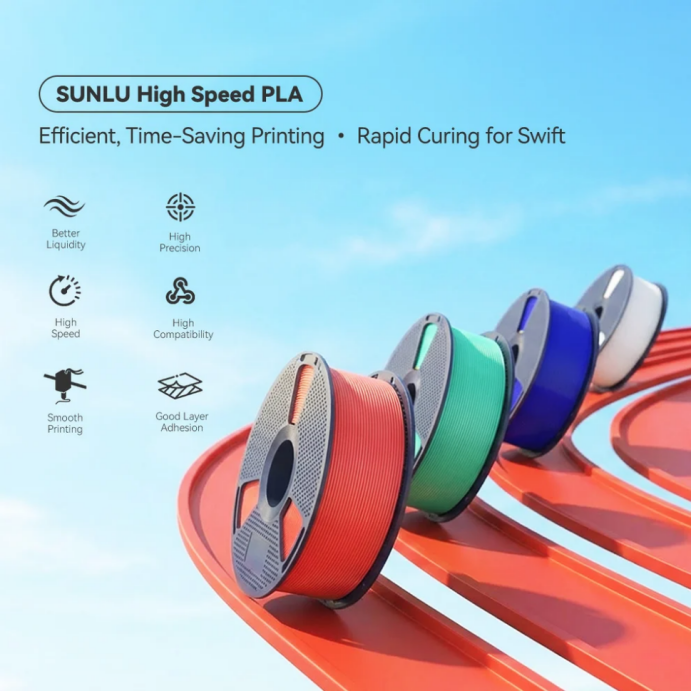
The widespread adoption of 1.75mm filament in modern desktop 3D printing reflects a combination of engineering considerations, hardware development, and industry standardization. Its dimensions offer practical advantages for extrusion and thermal control, while broad compatibility across printers, accessories, and filament supply systems has further strengthened its position as a common desktop printing standard.
During the early stages of additive manufacturing, industrial machines relied on thicker 2.85mm profiles because their bulky extruders could push large volumes of plastic without buckling. However, as 3D printing transitioned into compact desktop setups, the physical limits of stepper motors and hotend heating capacities became the primary bottlenecks. Standardizing on a thinner profile offered a practical engineering solution, allowing manufacturers to build faster, more responsive, and highly precise FDM printers for everyday makers.
Extruder Mechanics and Stepper Motor Load
The physical force required to push filament through a heated hotend directly impacts the performance and longevity of a 3D printer. Thicker materials demand significantly higher torque from the extruder motor because the cross-sectional area is much larger. This increased mechanical load may place additional demands on the extruder motor and feeding mechanism, potentially affecting extrusion consistency during rapid print moves or complex retraction sequences.
By contrast, a standard 1.75mm 3D Printing Filament requires much less physical force to feed into the melt zone. The reduced torque demand allows for the use of lighter stepper motors, which drastically reduces the overall weight of the moving toolhead. Lighter toolheads translate directly into higher acceleration rates and reduced mechanical inertia. When the print carriage changes direction rapidly, lower inertia helps to minimize unwanted vibration artifacts, such as ghosting or ringing, on the exterior walls of the printed object. This dynamic responsiveness is a critical factor in achieving modern high-speed printing standards.
Thermal Transfer and Melt Zone Efficiency
Thermal transfer efficiency is another fundamental reason for the widespread adoption of the thinner standard. A filament with a smaller cross-sectional area possesses a higher surface-area-to-volume ratio compared to thicker alternatives. This geometric advantage allows the heating element inside the hotend to penetrate and melt the polymer core much more rapidly.
Faster melting helps to maintain a consistent volumetric flow rate, even when the printer is operating at aggressive speeds. Additionally, the reduced thermal mass entering the melt zone allows the heater block to recover its target temperature more quickly after a sudden burst of extrusion. When working with a 3D Printing Filament 1.75 mm, this rapid thermal recovery significantly reduces the risk of under-extrusion during complex infill patterns or sudden speed changes. The result is more reliable layer bonding and a smoother surface finish across the entire print.
Firmware Compensation and Pressure Advance
Modern 3D printing relies heavily on software algorithms to compensate for the physical behavior of molten plastic. Advanced features such as Pressure Advance or Linear Advance calculate the exact amount of pressure required inside the nozzle based on the filament’s diameter. A uniform diameter helps the firmware accurately predict and compensate for the compression of the polymer as it exits the nozzle.
When using a high-quality spool from an established manufacturer like SUNLU, the strict dimensional tolerances provide the consistency these complex algorithms require. The widespread availability of high-tolerance 1.75mm filament enables these advanced firmware features to function as intended, resulting in exceptionally crisp geometric details.
Desktop Printer Compatibility and Ecosystem Standardization
Beyond the printer hardware itself, the physical size and weight of the filament spool play a significant role in the user experience. A standard 1kg spool of 1.75mm filament is relatively compact and lightweight. Thicker 2.85mm filament requires significantly larger and heavier spools to hold the same length of material.
Lighter spools are much easier to handle and place less physical strain on the printer’s gantry, the spool holder, and the filament feed path. This compact form factor has also facilitated the rise of multi-material systems and enclosed filament dryers, which often require tight, standardized dimensions to function effectively. The 1.75mm format fits neatly into these modern ecosystem accessories, cementing its status as the desktop standard.
Practical Maintenance and Moisture Control
While the dimensional profile sets the mechanical baseline, maintaining print quality over time requires attention to environmental factors. Thermoplastic filaments are mildly hygroscopic, meaning they can absorb ambient moisture from the air over time. When a damp spool is heated inside the hotend, the trapped moisture turns into steam, causing popping sounds and creating microscopic voids in the extruded plastic.
These bubbles disrupt the smooth surface finish and can weaken the structural integrity of the final part. To prevent moisture degradation, it is advisable to store spools in a sealed container with fresh desiccant. Under proper dry conditions, the shelf life of standard filaments is commonly around one and a half to two years. Choosing materials with consistent diameter tolerances reduces mechanical friction in the feed path, while proper storage ensures the polymer retains its optimal melt properties for reliable daily printing.
