As utility-scale energy storage projects become larger and more complex, reliability is no longer optional. Grid operators, EPC contractors, and OEM partners need systems that can continue operating even when part of the equipment is under maintenance or unexpected faults occur. This requirement has accelerated the adoption of modular architectures. In modern energy infrastructure, parallel configuration and redundancy have become essential design concepts rather than additional features.
Utility-Scale Liquid-Cooled Containerized BESS solutions are built around this idea. Instead of relying on a single large battery unit, these systems divide energy storage into standardized modules that work together while maintaining operational independence. This architecture improves availability and allows capacity expansion without redesigning the entire project.
Why Parallel Configuration Matters in Large Energy Storage Projects
Conventional centralized battery systems often create a single point of failure. If a major component stops working, the performance of the entire system can be affected. In contrast, modular systems support parallel operation, where multiple battery clusters share loads simultaneously.
Parallel configuration distributes current and power demand among several units. This helps reduce stress on individual battery modules and improves overall efficiency. More importantly, it allows energy capacity and output power to be increased gradually. System integrators can expand projects according to customer requirements instead of investing in oversized infrastructure from the beginning.
This design philosophy is particularly valuable for utility-scale applications, microgrids, renewable energy integration, and industrial backup systems.
Understanding Redundancy in Energy Storage Architecture
Redundancy refers to the ability of a system to maintain operation when one component experiences failure or requires servicing. In battery energy storage systems, redundancy can be achieved at different levels, including battery clusters, battery management systems, cooling units, and power conversion equipment.
For example, if one battery cluster becomes unavailable, other clusters operating in parallel can continue supplying power. This reduces downtime and enhances system reliability. Such an architecture is especially important in industrial facilities where uninterrupted operation is critical.
From an engineering perspective, redundancy also simplifies maintenance. Fault isolation can be performed without shutting down the entire installation, helping operators minimize operational losses.
The Role of Liquid Cooling in System Stability
As battery capacities increase, thermal management becomes more challenging. Uneven temperatures can accelerate cell aging and reduce overall efficiency. Liquid cooling technology addresses these issues by maintaining a consistent operating environment.
Compared with air cooling, liquid cooling offers better heat transfer performance and more accurate temperature control. Industry studies have shown that temperature uniformity contributes directly to battery cycle life and safety. Stable thermal conditions also improve consistency among battery clusters operating in parallel.
This is one reason why Utility-Scale Liquid-Cooled Containerized BESS solutions are increasingly used in grid-scale and commercial energy storage projects.
How Modular Design Supports Flexible Expansion
Scalability is one of the most important advantages of modular systems. Capacity requirements often change during the lifecycle of an energy project. A modular architecture allows additional units to be integrated without replacing existing equipment.
This flexibility benefits EPC companies and OEM partners that need adaptable platforms for different markets. Standardized modules simplify transportation, commissioning, and after-sales support. Inventory management also becomes more efficient because the same platform can serve multiple applications.
For large renewable energy projects, modularity reduces initial investment risks while preserving the possibility of future expansion.
A Practical Example from Dyness
An example of this approach is the industrial modular storage system developed by Dyness. The company focuses on energy storage technologies and provides solutions for residential, commercial, and utility-scale applications through cooperation with system integrators, distributors, and OEM or ODM partners.
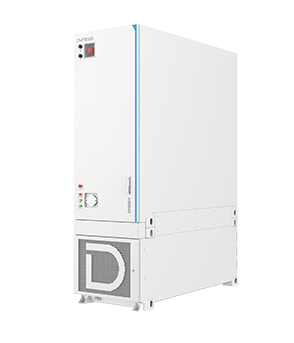
According to official information, the DH800Y adopts a liquid-cooled modular design. The system integrates battery modules, battery management systems, liquid cooling technology, and fire protection mechanisms into a compact platform. It supports high energy density and intelligent thermal management to improve system efficiency and safety.
Its modular architecture enables multiple units to operate in parallel, making capacity expansion more convenient. Since each module functions independently, maintenance activities can be carried out without significantly affecting overall operation. This characteristic improves availability and supports redundant system design, which is particularly important for industrial and utility-scale projects.
As a Utility-Scale Liquid-Cooled Containerized BESS solution, the DH800Y is designed to address the requirements of large-scale renewable integration, peak shaving, frequency regulation, and industrial energy storage scenarios.
Why Reliability Is Becoming a Competitive Advantage
The growth of renewable energy and distributed power systems is increasing demand for resilient infrastructure. Reliability now influences not only operational performance but also project economics. Downtime can result in energy losses and increased maintenance costs.
Industrial modular storage systems provide a practical answer to these challenges. Through parallel configuration and redundancy, they improve fault tolerance and simplify system expansion. Combined with liquid cooling and intelligent control technologies, Utility-Scale Liquid-Cooled Containerized BESS platforms are helping create more reliable and scalable energy storage architectures.
For OEM and ODM partners seeking long-term flexibility, modular design offers an efficient foundation for building customized energy storage solutions that can evolve with future energy demands.
