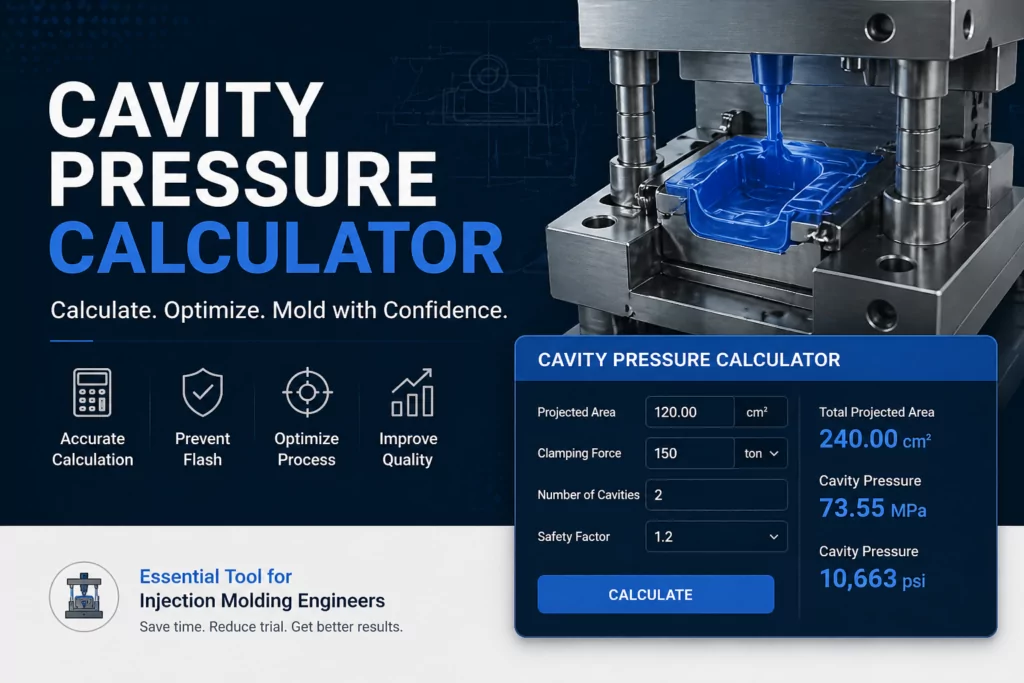
Mold design is a critical stage in the injection molding process, and determining the correct clamping force is essential to ensure stable production and product quality. For manufacturing businesses, an inaccurate clamping force requirement can lead to mold damage, flash defects, or inefficient equipment utilization. Therefore, understanding how to determine the required clamping force for mold design is not only a technical task but also a key factor in improving operational efficiency. Tools such as the tonnage calculator injection molding provide valuable support by helping engineers quickly estimate and verify clamping force requirements during the design phase.
Relationship Between Mold Design and Clamping Force
Livepoint Tooling Clamping force requirements are directly influenced by mold structure and part design. The projected area of the part, defined as the maximum cross-sectional area perpendicular to the injection direction, is the primary factor in calculating clamping force. As the projected area increases, the pressure exerted by molten plastic inside the mold cavity also rises, requiring higher clamping force to keep the mold closed.
In addition, mold complexity plays an important role. Multi-cavity molds significantly increase the total projected area, which directly raises the required clamping force. Similarly, molds with deep cavities, thin walls, or intricate geometries create uneven pressure distribution, making accurate calculation even more critical. Integrating clamping force estimation into the early mold design stage helps avoid costly design modifications later and ensures that the selected injection molding machine can meet production requirements.
Practical Calculation Methods and Tool Application
Determining the required clamping force typically involves a structured calculation process. First, engineers calculate the total projected area of all cavities. Second, they identify the appropriate injection pressure based on the selected plastic material, as different materials have varying flow characteristics and pressure requirements. Third, a safety factor—usually between 1.2 and 1.5—is applied to account for process fluctuations, material variations, and mold wear.
Manual calculation can be time-consuming and prone to error, especially for complex molds. This is where the injection molding tonnage calculator and tonnage calculator injection molding become essential tools. By inputting parameters such as projected area, material type, and cavity number, engineers can quickly obtain accurate clamping force values. These tools not only improve calculation efficiency but also reduce the risk of misjudgment during equipment selection.
In practical applications, the calculated clamping force should also be compared with machine specifications, including tie-bar spacing, shot capacity, and platen size, to ensure full compatibility with the mold.
Optimization for Production Stability and Mold Longevity
Accurately determining clamping force is not just about meeting minimum requirements—it is about achieving an optimal balance. Insufficient clamping force can result in flash, part deformation, and quality instability, while excessive clamping force increases energy consumption and accelerates mold wear, shortening its service life.
To optimize clamping force, engineers should combine calculation results with real production feedback. Trial runs, process monitoring, and data collection help refine initial estimates and ensure that the selected clamping force aligns with actual production conditions. Additionally, documenting key parameters—such as projected area assumptions, material pressure references, cavity layout, and safety factors—supports long-term process standardization and repeatability.
By integrating accurate calculation methods, digital tools, and continuous optimization, manufacturers can ensure reliable mold performance, reduce defects, and improve overall production efficiency. A well-defined clamping force strategy ultimately supports both cost control and long-term competitiveness in injection molding operations.
