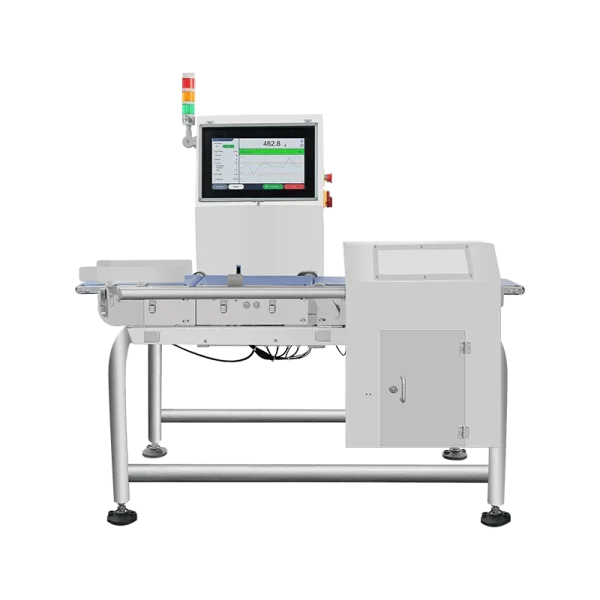
Industrial food processing requires precise weight verification to guarantee product uniformity and strict regulatory compliance across global markets. Every single package leaving the factory must match exact net weight specifications to avoid severe statutory penalties.
Modern checkweighers serve as automated inline inspection systems that measure individual item masses continuously on the fly. Deploying this specialized technology eliminates manual weighing bottlenecks across active production lines without slowing down overall product throughput or compromising measurement precision.
Factory operators rely on these robust systems to maintain consistent quality standards across high-speed manufacturing shifts. Understanding what these instruments are requires examining their core physical architecture, dynamic load cell physics, and electronic filtering mechanisms.
This fundamental technology transforms passive conveyor lines into active quality control checkpoints that protect corporate profitability and brand reputation.
Definition and Core Purpose in Food Processing
Modern food manufacturing lines handle thousands of packaged items every single minute, making manual sampling completely impractical. An automated industrial system acts as a critical quality control gateway installed directly along high-speed conveyor systems.
Its core operational purpose is to verify that every retail box, pouch, or plastic tray meets designated weight thresholds. Unchecked weight discrepancies lead to costly regulatory fines and deeply dissatisfied retail customers globally.
Operating entirely inline, these precision systems capture the mass of each passing item without disrupting transport velocity. They isolate out-of-tolerance units before secondary packaging begins across the plant floor.
This continuous verification process protects corporate brand equity and maintains strict adherence to international Weights and Measures standards. Plant supervisors depend on real-time data feeds to monitor overall filling line stability and performance drift.
Dynamic Load Cell Mechanics and Gravitational Sensing
Weighing edible items while they move across a high-speed conveyor introduces significant mechanical vibration and inertia interference. Specialized strain gauge load cells or electromagnetic force restoration sensors capture gross package weight instantly during active transit. These precision components measure the downward gravitational force exerted as the product traverses the active weighing deck.
Maintaining mechanical stability across the weighing zone prevents ambient factory vibrations from skewing critical weight data during operations. Careful isolation of mechanical components ensures that transient shocks from nearby machinery do not interfere with delicate electrical readings. Proper belt tensioning and precision roller alignment further eliminate friction anomalies during high-speed transit.
Structural rigidity remains essential to guarantee repeatable measurement results across millions of operational cycles under demanding factory conditions. Environmental factors such as ambient temperature shifts and humidity levels must also be managed by internal compensation circuits. These mechanical safeguards lay the foundational physical framework necessary for high-precision dynamic weighing systems.
Digital Signal Processing and Noise Filtration
Raw electrical signals generated during dynamic weighing often contain background noise from motor vibrations and belt friction. Advanced digital signal processing filters out these mechanical disturbances to isolate true net weight values accurately. High-speed microprocessors calculate final mass by subtracting pre-programmed tare values from gross measurements within milliseconds.
Operators can configure custom filtering parameters to match unique product consistencies and conveyor velocities. This rigorous mathematical filtration ensures that minor package instabilities never trigger false rejections or compromise overall measurement accuracy.
Digital filters smooth out transient electrical spikes, delivering pristine data sets to the central control terminal. Engineers rely on these robust filtering tools to guarantee absolute measurement fidelity under heavy factory workloads. Advanced algorithms continuously adapt to subtle changes in conveyor belt wear and ambient temperature variations to maintain calibration stability.
Inline Sorting Mechanisms and Upstream Feedback Control
Once the control unit determines package mass, it compares the data against pre-set upper and lower weight limits. Items falling within acceptable parameters continue smoothly down the primary conveyor toward secondary packaging stations. Non-compliant units trigger immediate physical sorting actions from the control terminal using high-speed pneumatic pushers.
Systems engineered by Easyweigh execute these sorting routines with millimeter precision to prevent collateral product loss during sorting. Furthermore, advanced checkweighers feature bidirectional communication links with upstream fillers, multi-head weighers, and liquid dispensers. When weight trends drift toward tolerance limits, automated correction pulses adjust dosing volumes instantly before batches fail.
This proactive feedback loop minimizes systemic filling drift significantly before batch-wide weight errors escalate across active production shifts. Integrating these systems into plant control networks transforms passive inspection hardware into active process optimization centers. Operators save valuable time by eliminating manual calibration adjustments during heavy manufacturing schedules.
Ensuring Regulatory Compliance and Net Weight Accuracy
Strict global regulations penalize food processors severely for delivering underfilled consumer packages below statutory minimums. Conversely, unchecked overfilling results in massive annual financial losses due to wasted raw ingredients and expensive packaging materials. Installing robust checkweighers eliminates guesswork by enforcing strict target weight boundaries consistently across all active batches.
Advanced software provided by Easyweigh delivers comprehensive visualization tools that highlight recurring filling inconsistencies instantly for plant engineers. Comprehensive data logging records standard deviation and total output volume across every active shift for audit readiness. Detailed statistical tracking empowers quality management teams to maintain peak operational efficiency and reduce long-term process variance.
Selecting rugged inspection solutions provided by Easyweigh ensures long-term compliance, reduced ingredient giveaway, and uncompromised brand protection. Navigating the financial and regulatory demands of modern food packaging requires dependable inline verification technology designed for harsh environments. Integrating precision measurement tools secures enduring operational excellence and market competitiveness worldwide across all distribution channels.
