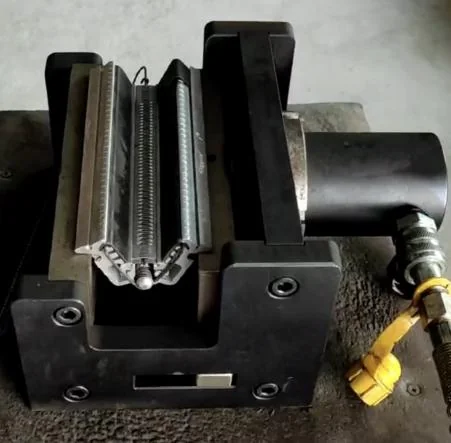
Conveyor maintenance crews frequently battle premature mechanical joint failures along demanding industrial bulk handling lines. Traditional manual lacing methods rely extensively on physical arm strength, mechanical lever linkages, or handheld ratchet rollers. Such mechanical dependency introduces erratic clamping pressure across the joint width, causing uneven fastener seating, skewed pitch dimensions, and severely compromised load distribution across internal belt plies.
Operator fatigue significantly worsens these dimensional discrepancies, particularly during urgent graveyard-shift conveyor repairs. Millwrights naturally apply varying degrees of leverage across wider belt profiles, leaving center fasteners noticeably looser than edge hooks. Utilizing an engineered hydraulic belt fastener machine eliminates this physical variability, establishing repeatable mechanical precision that manual ratchets cannot replicate across high-tensile carcasses.
Inconsistent hand-applied force also generates progressive structural distortion along temporary alignment combs during lacing. Intake engineers observe that uneven manual strokes produce irregular, scalloped splice seams across working conveyor belting. These microscopic alignment errors create severe localized stress concentrations, forcing select fastener loops to carry excessive tension while adjacent hooks remain mechanically underutilized under standard operating plant loads.
Fluid Power and Cross-Belt Pressure Equalization
Pascal’s principle dictates that confined hydraulic fluid transmits applied force equally in every direction throughout an operational system. Precision hydraulic clamping cylinders deliver balanced mechanical tonnage simultaneously across the entire width of the lacer head. Rather than relying on incremental, stepped manual crimping, uniform fluid displacement guarantees that every fastener leg engages belt covers at the identical velocity and penetration pressure.
Equalized hydraulic compression across the transverse belt axis prevents localized carcass crushing and surface cover distortion. Integrating a dedicated hydraulic machine system into scheduled maintenance routines ensures that neither belt edges nor center sections absorb excessive clamping force. Fastener points cleanly pierce carcass fabrics without tearing reinforcement cords or displacing protective rubber covers along the critical splice interface zone.
Internal relief valves integrated within hydraulic power units prevent field technicians from over-crimping mechanical splices. Factory-calibrated hydraulic bypass thresholds halt cylinder stroke extension the exact moment specified compression limits are reached. These positive mechanical stops protect delicate carcass weaves from irreversible internal crushing, preserving fundamental belt tensile ratings across the working mechanical joint line.
Hook Clinch Geometry and Carcass Fiber Preservation
Point penetration geometry determines whether an installed mechanical fastener securely grips carcass threads or severs structural fabric. Manual impact tools frequently crush outer belt covers while driving wire points at unpredictable angles. Controlled stroke actuation from a specialized hydraulic belt fastener machine guides beveled hook points smoothly through carcass plies, parting synthetic reinforcement fibers rather than shearing them through blunt force.
Controlled point curling produces a smooth, low-profile clinch that anchors tightly against the bottom carcass fabric. Consistent hydraulic travel velocity enables fastener legs to fold smoothly into shaped anvil pockets without work-hardening the metal wire. Fasteners achieve maximum withdrawal resistance without developing micro-fractures that accelerate mechanical fatigue under continuous cyclic bending over terminal drive pulleys.
Intake supplies rigid alignment combs and precision anvil plates that maintain exact fastener pitch throughout high-pressure cycles. Stable comb geometry prevents wire fastener legs from twisting or splaying outward under intense hydraulic clamping force. Preserving parallel loop orientation guarantees that opposing belt ends mesh seamlessly, simplifying hinge pin insertion and preventing uneven pin wear during demanding operational runs.
Operational Decoupling and Shift-to-Shift Repeatability
Staff turnover across processing plants regularly causes noticeable quality swings in mechanical conveyor splicing. Veteran technicians possess the physical intuition to operate manual lacers reliably, whereas newer operators frequently under-crimp or over-tighten fastener strips. Adopting a standardized hydraulic machine system completely decouples splice quality from individual physical capability, hand grip strength, and technician fatigue levels during emergency shutdowns.
Straightforward valve controls and automated clamping cycles convert complex mechanical splicing procedures into predictable, foolproof maintenance routines. Technicians simply square the belt end, position the comb assembly, and activate the hydraulic power pack. Every finished splice delivers identical clinch tightness and dimensional uniformity, whether completed during a scheduled workshop overhaul or an emergency midnight breakdown on the plant floor.
Rapid cycle execution substantially shortens conveyor downtime during planned belt changeouts and emergency splice repairs. High-output hydraulic heads embed entire fastener strips in single, smooth strokes, replacing tedious manual ratchet passes across wide belts. Accelerated lacing speed reduces operational downtime while ensuring technicians never rush or skip critical clinch inspection steps to meet strict production restart deadlines.
Quantifying Mechanical Splice Longevity and Scraper Clearance
Uniform splice thickness across the belt width dictates how mechanical fasteners interact with conveyor belt cleaning systems. Irregularly raised fastener crowns inevitably snag against primary cleaner blades, damaging expensive tungsten carbide scrapers and ripping out fastener clips. Utilizing a high-output hydraulic belt fastener machine compresses crowns flush with top belt covers, creating a flat joint that glides beneath scrapers without blade chatter.
Reduced cleaner impact shock translates directly into prolonged mechanical joint life and lower maintenance costs. Eliminating raised hook points prevents mechanical snagging, stabilizes belt tracking, and minimizes joint wear against return idlers and snub pulleys. Equalized tension distribution across all fastener legs also eliminates premature corner tear-outs, keeping heavy-duty conveyor systems running smoothly under continuous material loading cycles.
Plant engineers committed to maximizing conveyor reliability recognize that repeatable mechanical lacing protects high-value belting assets. Installing an industrial hydraulic machine system alongside high-grade fastener strips standardizes splicing outcomes across diverse factory shifts. Intake manufactures durable hydraulic lacing equipment that ensures every mechanical joint achieves superior tensile retention, smooth scraper clearance, and dependable service life in demanding material handling environments.
